|
|
The Problem |
|
|---|

 |
|
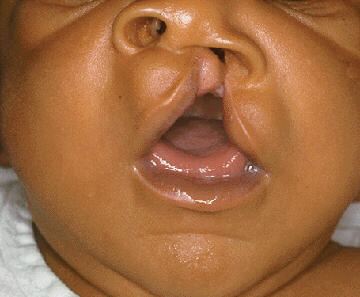
The unilateral cleft lip deformity results from the embryological failure of two facial processes, the medial naso-frontal and the maxillary, to merge. Two-thirds of such patients also have cleft palate. This case demonstrates the anatomic changes characteristic of a wide, complete cleft: the lip medial to the cleft is drawn upward, the lip lateral to the cleft is pulled laterally, the nasal ala is splayed and flattened, the ipsilateral nasal dome is pulled down, and the columella is deviated medially. |
 |
|
The lack of maxillary alveolar arch continuity, consequent to the cleft palate, results in an outward malrotation of the pre-maxilla and further distortion of lip and nose anatomy. In spite of this cleft's alarming appearance, it's important to realize that no tissue is missing; it is only displaced. During fetal development, the absence of normal muscle and skin tension across the cleft often prevents the lateral lip element from attaining its full size. This finding is usually more apparent than real; such tissue readily stretches out to normal proportions when repaired. Rarely will there be a significant soft tissue deficiency. Therefore, for the majority of unilateral cleft lips, the primary problem is that of tissue malposition, not deficiency. |
|
|