|
|
Millard's Rotation / Advancement Repair |
|
|---|

|
|
|
Millard was the first to recognize that
the philtral unit was present and merely malrotated in
unilateral clefts5. Having made the diagnosis, he
immediately developed the R-A concept: return this
malpositioned anatomic unit into its normal position (the
rotation flap); advance the lateral lip (the advancement
flap) to fill the resultant defect. Fig.10 demonstrates the essential features of Millard's R-A repair: Fig.10A. The complete philtral unit is marked for rotation and the lateral element is marked for advancement. Fig.10B. The complete philtral unit has been rotated into normal position and the lateral lip is ready for advancement. Fig.10C. The immediate postoperative result. Fig.10D. The six week postoperative result. Note how the scar of the rotation flap imitates the normal philtral column, the alar base scar resides in the alar crease, and the remaining lip and nasal elements into more normal positions. |

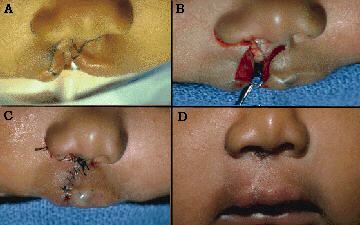
Fig. 10 |
|
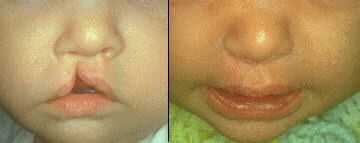
The R-A repair is applicable to all unilateral cleft lips, incomplete (Fig.11) as well as complete (Fig.12). |
|
Fig. 11
Fig. 12 |
|
POOL REPAIR (is it a modified R-A or triangle flap repair?) Pool9 recommends a "modified Millard
repair" for complete clefts with tissue deficiency in the
lateral element. |
|
|